ABOUT US
GET A FREE QUOTE
-
Home

-
Products
-
First-Aid Equipment
-
Defibrillator
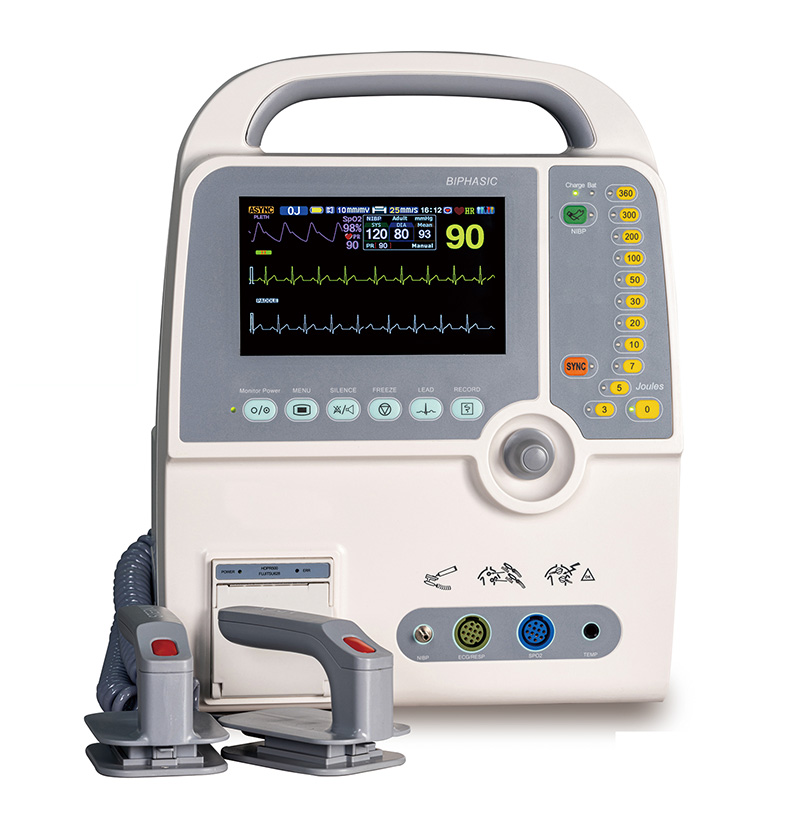
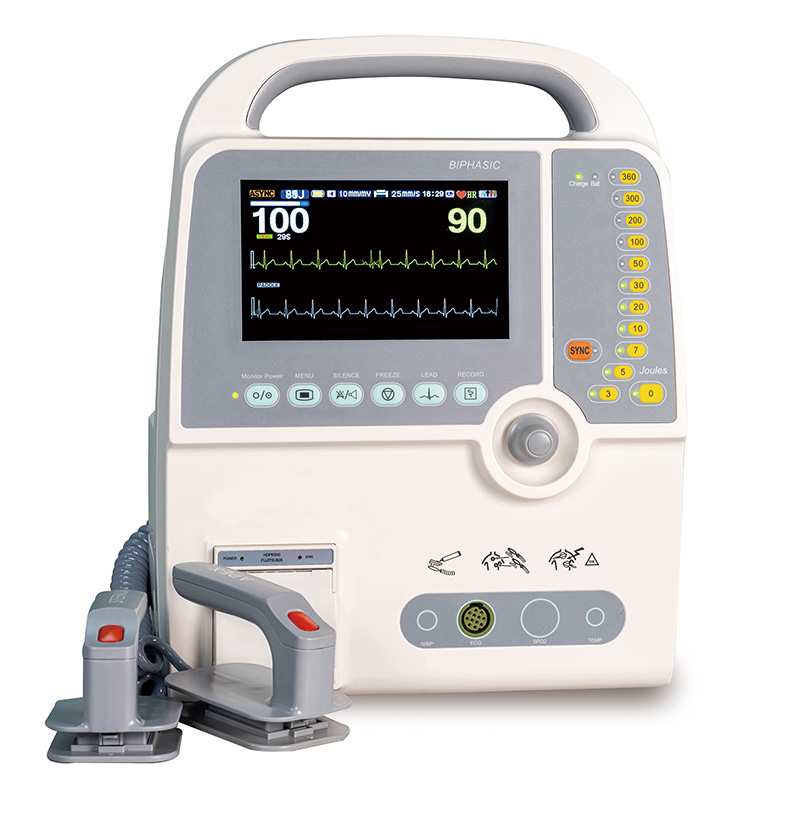
- DEF-5000X Defibrillator Monitor
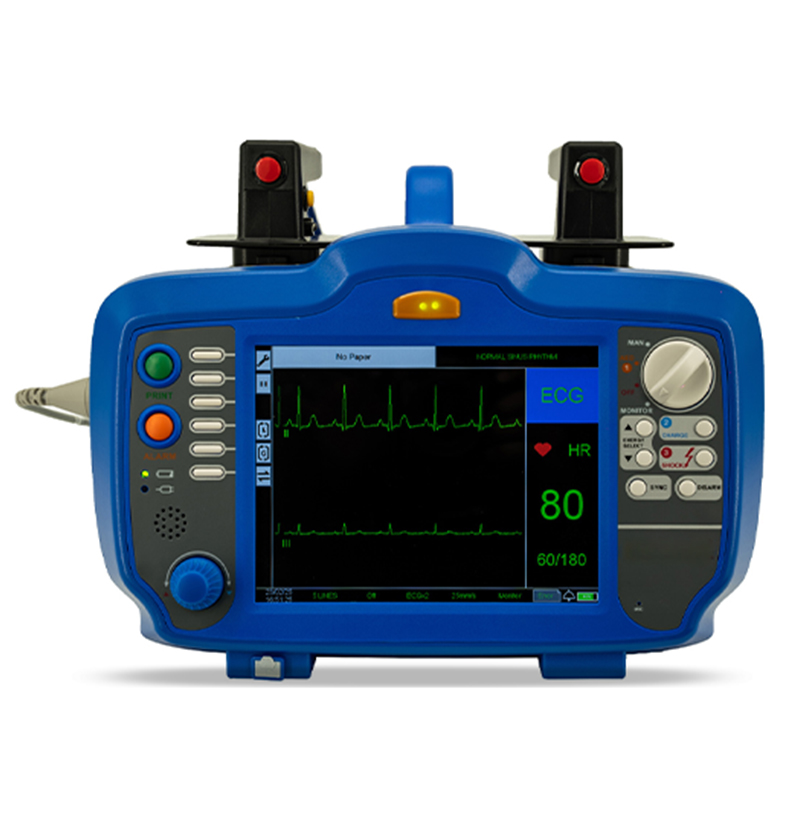
Features
Display
Screen type: High resolution & full color
Screen size: 8 inch
Sweep speed: 25mm/sec
Information: Heart Rate.Lead/Pads. Alarm. On/Off. SpO2. AED
Functions and prompts Alarm selection and delivered energy limits.
6 languages to choose from
Defibrillator
Waveform: Biphasic (BTE)
Recharge Time: Less than 7 seconds with a new, fully charged battery.
Energy display: Monitor display shows both selected and delivered energy.
Type of charging prompts: Voice and visual prompts.
Electrode impedance measurement range: 0-250 ohms.
ECG Monitoring
Patient connection: 3-lead ECG cable or 5-lead ECG cable paddles.
Lead selection: Display on monitor paddles I II III AVR AVL AVF V.
ECG size: 0.25 0.5 1 1.5 2 4 cm/mV displayed on the monitor.
Heart rate: 20-300 BPM.
Heart rate alarm: display on monitor on/off, user selectable.
Smart alarms: beep/voice announcements indicate shockable rhythms.
Battery
Type: rechargeable Ni MH battery 12V.
Operating time: for a new, fully charged battery:
60 defibrillator discharges at maximum energy or at least 3 hours of continuous ECG monitoring.
Other parameters affect operating time for various functions.
SpO2 Module (Options)
Measurement range: 30~100% ±2% between 80%~90% other ±5%
Alarm range: user defined upper and lower limit.
Alarm accuracy: ± 10%within the set values.
Alarm time accuracy: less than 12 sec.
Pulse Oximeter
Recorder
Paper: 50mm thermal.
Speed: 12.5mm/sec. 25mm/sec.50mm/sec. User selectable delay of 6 seconds.
Printing method: High resolution thermal print head.
Print Modes: Manual or automatic, user configurable.
On/off control: front panel and paddle.
Automatic function: 9-second recording triggered by alarm activation,
defibrillator charge or defibrillator discharge.
EtCO2 Module (Options)
CO2 range 0 to 13% (0-98.8mmHg@BTPS)
CO2 accuracy < 5.0% CO2 (for BTPS) ± 3 mmHg
> 5.0% CO2 (at BTPS) < 10% of reading
Respiratory rate 3~60 BPM Measurement accuracy ± 1BPM
Manual Mode
Energy selection: Selectable at 2 5 7 10 20 30 50 70 100 150 200 300 360 joules.
Synchronized mode: Synchronizes the defibrillator pulse with the R-wave.
The message “SYNC” is displayed on the monitor.
NIBP(Options)
Method: automatic oscillation
Working mode: manual/automatic
Measure: adult: 10-250mmHg
Ement: pediatric: 10-200mmHg
Ement: neonatal: 10-135mmHg
AED Mode
AED function: automatic analysis and charging x3 with programmable automatic energy level selection, on-screen prompts and voice prompts.
Shock capable rhythms: Ventricular fibrillation with amplitude>=200uV Ventricular tachycardia with rates>=140bpm and QRS complex
wave duration>=140ms.
Charge control: front panel, push button on paddle.
Prompts: Voice and visual prompts.
Pacemaker (Options)
Type: VVI
Pulse type: rectangular, constant current
Pulse amplitude: 0 to 180 mA ± 10% or 5 mA (whichever is greater).
Pacing frequency: Variable from 30 ppm to 180 ppm ±1.5% (increments or decrements by a value of 2 ppm)
Multifunctional Electrode: (MFE) Pads: multipurpose defibrillation/pacing electrodes
Pause: pacing pulse rate is reduced by a factor of 4 upon activation
Refractory period: NC(VVI requirements do not have this specification)
Pulse width: (20+1.5 ms)
Output protection: Fully defibrillator protected and isolated
Technical Specification
Specification of the physical electronic isolation defibrillator
Electromagnetic compatibility of the battery and rhythm detection
Performance are described in this section
Data Acquisition and Analysis
The Defibrillator is no longer automatically set to a specific frequency response.
There are two diagnostic frequency options: 0.05-150 Hz diagnostic frequency filter and 0.05-40 Hz filtered diagnostic frequency filter.
See chapter 7 for switching between these two options.
Waveform Details
The following tables show the waveforms provided by the defibrillator when connected to resistive loads of 25, 50, and 100 ohms and set to its maximum output.
The waveforms are identified by the defibrillator peak current values (Ip) for two-phase operation:
Duration of the first output phase (tphase1) and duration of the second output phase (tphase2).
The indicated values are within 10%.
Waveform: Truncated exponential curve Biphasic
Output Energy Accuracy
+/-10% or 1J (whichever is greater) at 50 ohms
+/-15% or 1J (whichever is greater) at 25 to 100 ohms
Charge Time
<06 seconds @200 J (with a Ni-MH 12 volt battery).
<12 seconds @360J (with a Ni-MH 12 volt battery after 15 discharges).
<15 seconds @360J(without battery 90% AC mains voltage)
Indication of the state of charge: acoustic and graphic.
Output
Adult paddle, pediatric adapter, and multipurpose hands-free adapter available.
Synchronizer: delivers power within 60 msec.
Disarm: Front panel switch.
Energy Select
External: 2 5 7 10 20 30 50 70 100 150 200 300 360 J.
Input
3-wire 5-core patient cable
Size: 8 inch
Type: color (TFT)
Screen resolution: 800×600 pixels.
Passing speed: 12.5mm/s 25mm/s 50mm/s
Line selection: I II III AVR AVL AVF V.
Frequency response: (user selectable).
0.7 to 20 Hz Operating mode
0.3 to 40 Hz Monitoring mode
0.05 to 150 Hz Analysis mode
0.5 to 30 Hz AED mode
Common mode rejection: >=60dB
Heart rate monitoring: 20 to 300 BPM.
Heart rate alarms: user selectable.
Size: 0.125 0.25 0.5 1 2 4 cm/mv and auto ranging.
ECG output: 1 V/mv.
Heart rate response to irregular rhythm: (AAMI EC13-1992 Section 4.1.2.1.e.)
Heart Rate SpO₂Alarm
Auditory: 5-pulse 800 tone with a PW of 150 msec, a PRI of 225 msec,and a repetition interval of 10 seconds.
Visual: The heart rate alarm flashes the displayed heart rate at 2 Hz.
This indicator is located at the top of the display and is 0.4″ high and 0.28 to 0.840″ wide, depending on the number of digits in the heart rate.
It is amber, black, white, or the color of the display text.
Lead Fault Alarm
Audible: trio tone with 3 pulses, 500 Hz, with a PW of 200 msec and a PRI of 310 msec.
When the HR alarm is triggered or the pacemaker is on, the lead error tone is repeated at a 20-second repetition interval.
Visual: When a lead error occurs, the message “LEAD FAULT” is displayed along with a dashed line across the width of the trace.
The text is 0.18″ high and is the color of the display text.
The dashed line is 5″ long and corresponds to the width of the display. The signal is not modulated
Physiological Alarms(SpO₂)(Options)
Acoustic: See heart rate alarm
Visual: Physiological alarms make the displayed parameter flash at 2 Hz.
The color is amber, white, or the same as the colored text on the display.
Mute Duration: 90 seconds.
NIBP (Options)
Method: automatic oscillation
Working mode: manual/automatic
Measure: adult: 10-250mmHg
Ement: pediatric: 10-200mmHg
Ement: neonatal: 10-135mmHg
End-tidal CO2(EtCO2)
Safety type ETCO2: BF
Power consumption 12.0V±0.2V DC
Power consumption 100mA(typical with pump on), 200mA(extreme conditions)
Operating temperature range 5~50℃
Shipping/storage temperature range -20~+70℃
Relative humidity 0-85%(non-condensing)
Dimensions 96×91×36mm
CO2 range 0 to 13% (0-98.8mmHg@BTPS)
CO2 accuracy<5.0% CO2 (at BTPS) ±3 mmHg
>5.0% CO2 (at BTPS) < 10% of reading
Respiratory rate 3~60 BPM
Measurement accuracy ±1 BPM
Warm-up time 10 seconds
Detector response time: 10mS,
System: depends on implementation, pneumatics and water separation technology
Flow control 50~250ml/min
Interface Highly configurable serial digital interface (TTL/RS232)
Automatic offset calibration based on time, temperature and as needed
Pacemaker(Options)
Type: VVI
Pulse type: rectangular, constant current
Pulse amplitude: 0 to 180 mA ± 10% or 5 mA(whichever is greater).
Pacing frequency: Variable from 30 ppm to 180 ppm ± 1.5% (increments or decrements by a value of 2 ppm)
Multi-Function Electrode: (MFE)Pads: Multi-purpose defibrillation/pacing electrodes
Pause: pacing pulse rate is reduced by a factor of 4 upon activation
Refractory period: NC (VVI requirements do not have this specification)
Pulse width: (20+1.5 ms)
Output protection: Fully defibrillator protected and isolated
Operating
Temperature*: 0 to 45°C
Humidity*(NC): 15 to 95% RH (30 to 90% with CO2 probe)
Vibration*: MIL-STD 810E
Shock/Fall*: MIL-STD 810E
Altitude: Up to 4572 M(15000 feet)
Transportation and Storage:
Temperature: -30 to 70℃ (-20 to 70℃ with CO2 probe)
Humidity: 15 to 95% RH (non-condensing)
Atmospheric pressure: 860 to 1060 hPa
Shock/Vibration:ISTA 1A
Enclosure protection*: Solid Foreign matter: IEC 529 IP2X
Water: IEC 529 IPX4.
All tests were performed in accordance with the defibrillation standard AAMI DF -2
Frequency Response
Automatically adjusted to the frequency response of the monitor.
Battery
High capacity type: Ni-MH 12V volt
Up to 4 hours ECG monitoring or 110 full energy charges or 3 hours combined ECG SpO₂and monitoring Proper battery maintenance is required to maintain maximum available capacity.
Low battery indicator:
Flashing low battery icon on display and flashing LED on front panel.
Recharge speed: 80% in 7.5 hours. 100% in 9 hours.
General
Weight: 4.95 kg(basic equipment).
Size: 13×12.5×5.3 inches (33×31.8×13.5 cm).
Operating Power
Ni-MH 12 volt
SAED Rhythm detection performance
The algorithm defibrillator SAED exceeds, the requirements of ANSI /AAMI.
Recorder
Type: high resolution thermal array.
Annotation: time date ECG lead ECG gain heart rate defibrillation and treatment summary ACLS events.
Paper width: 50 mm.
Paper speed: 25 mm/sec 50 mm/sec 12 leads 50 mm/sec
Delay: 6 sec.
Related Products
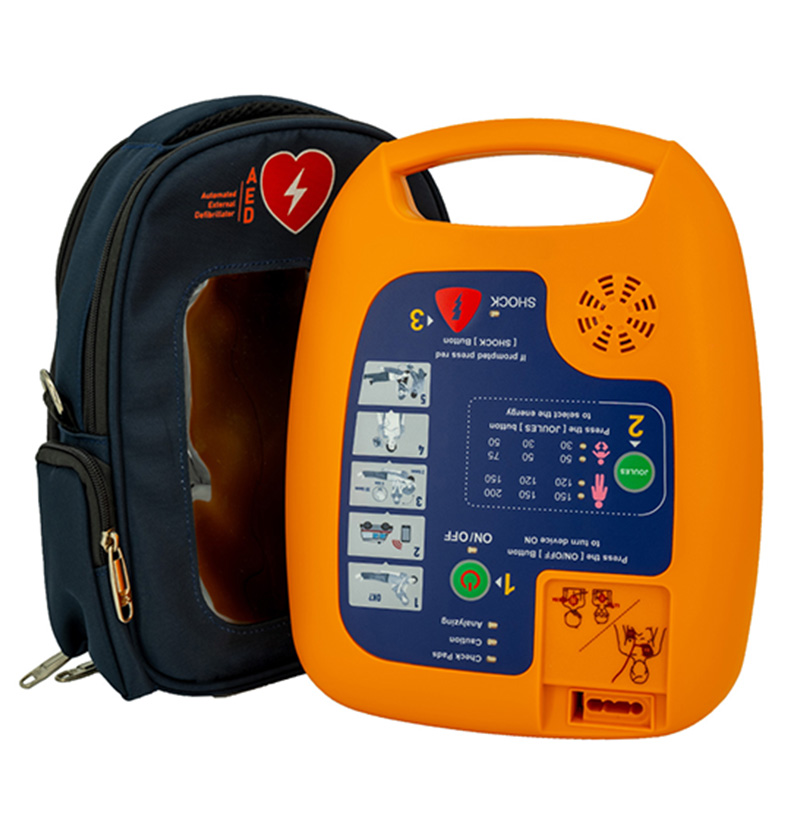
AED-5 Automated External Defibrillator
1. 2 languages to choose from (by end user)
2. Bluetooth for data transmission (standard)
3. Daily, weekly and monthly self test
4. Use of AED in pocket (does not need to be opened)
5. Extra pocket in the bag for first aid products
6. IPX55 water and dust resistant
7. 5 volume levels (by the end user)
8. Button for adult/child mode